
How to find tax deductions in your bank transactions with Claude or ChatGPT (Australia)
Connect your Australian bank accounts to Claude or ChatGPT, ask for a shortlist of possible work, business or rental expenses, then check each one against your receipts and the ATO rules.

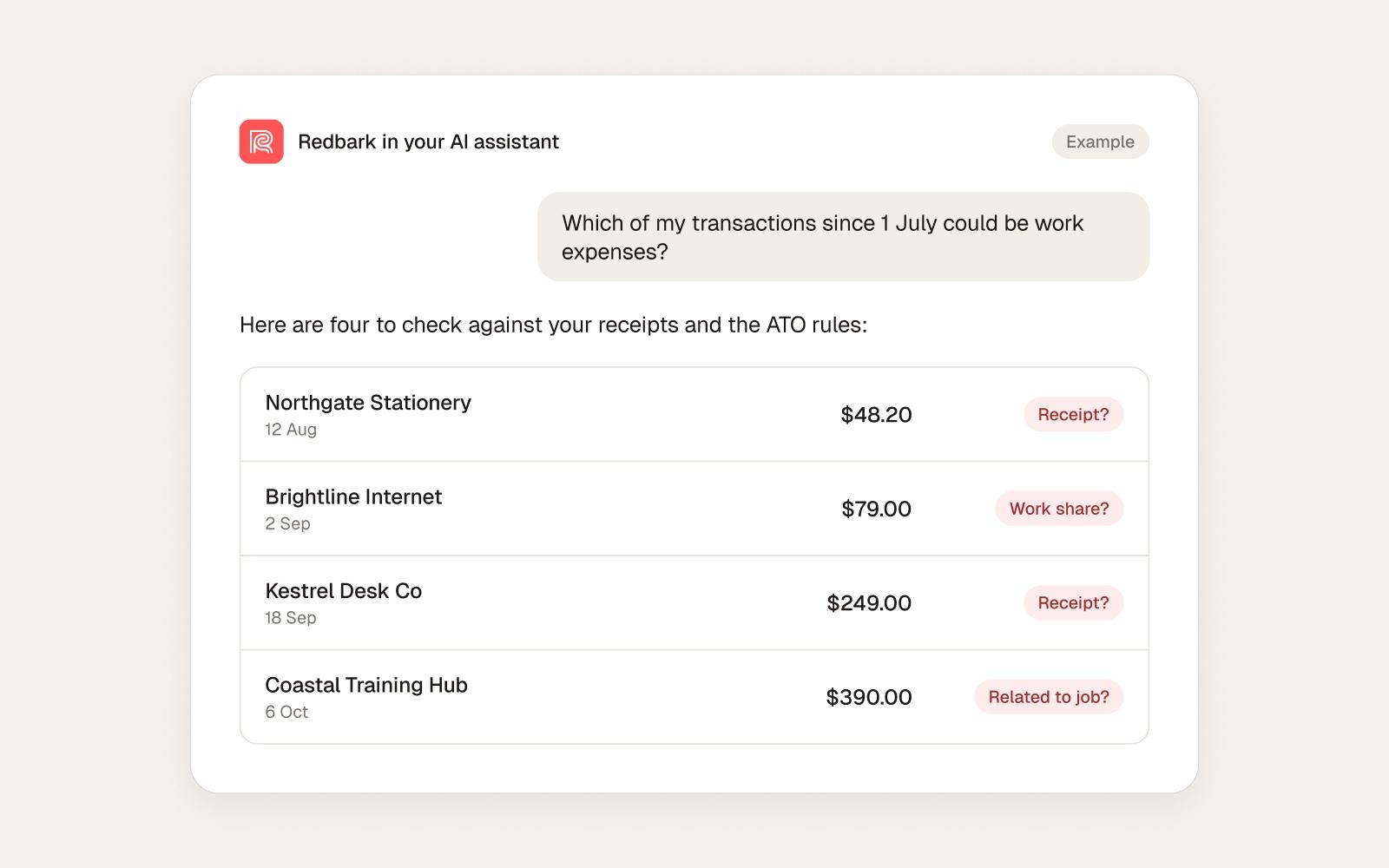
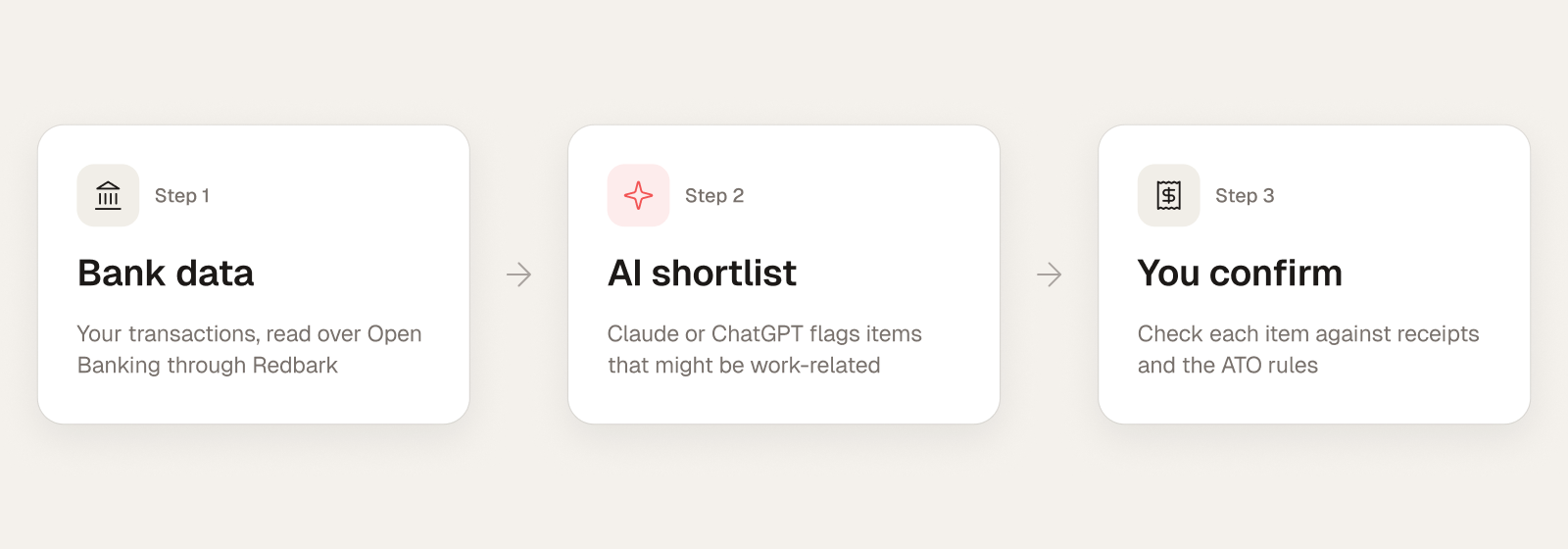
An AI assistant connected to your bank data can read a year of transactions and give you a shortlist of expenses that might be deductible. You then check each item against your receipts and the ATO rules, and keep only what qualifies. The AI finds candidates. It does not decide what you can claim.
This guide shows how to connect Australian bank accounts to Claude or ChatGPT with Redbark, which prompts to use for employees, sole traders and property investors, and how to turn the shortlist into a record you can hand to your tax agent.
This is general information, not tax advice. If your situation is complicated, talk to a registered tax agent.
Can AI find tax-deductible bank transactions?
Partly. An AI assistant is good at the search. It is not good at the judgement.
What it does well:
- Reading a whole year quickly. It can scan every transaction from 1 July to 30 June across all your accounts in one pass.
- Spotting likely candidates. Stationery suppliers, software subscriptions, professional memberships, training courses, internet bills and repairs tend to stand out by merchant name.
- Grouping and totalling. It can group by merchant or month and give you a total for each group.
- Asking the right follow-up. A good answer will flag items that need a work-use percentage or a receipt.
What it cannot do:
- Know why you bought something. A laptop or a phone plan can be private, work-related or both. Only you know the split.
- See your receipts. A bank transaction shows a merchant, a date and an amount. It does not show what was on the invoice.
- See reimbursements. The ATO says you can't claim an expense your employer paid for or reimbursed. Your bank feed may not show that link.
- Split out GST. For BAS, the GST amount comes from the tax invoice, not from the bank line.
- Apply the rules for you. Models can be confidently wrong about tax. Treat every item on the list as "check this", never as "claim this".
The ATO's three golden rules for work-related deductions are a good filter for the shortlist. You must have spent the money yourself and not been reimbursed. The expense must directly relate to earning your income. And you must have a record to prove it, usually a receipt. If the expense was for both work and private use, you can only claim the work part. See Claiming deductions on the ATO site.
How do I connect my Australian bank account to Claude or ChatGPT?
Redbark connects your Australian bank accounts over Open Banking under the Consumer Data Right (CDR), then makes them available to your AI assistant through the Redbark MCP server. MCP (Model Context Protocol) is the standard Claude, ChatGPT and other assistants use to call outside tools. There is a full walkthrough in how to connect an Australian bank account to Claude or ChatGPT.
The short version:
- Sign up at app.redbark.com and connect your bank. You choose your bank in Fiskil's CDR consent screen and approve access. CommBank, ANZ, NAB, Westpac and most smaller banks and credit unions are supported.
- In Claude, open Customize > Connectors, choose Add custom connector and paste
https://mcp.redbark.com/mcp. In ChatGPT, turn on Developer Mode and create a connector withhttps://mcp.redbark.com/mcp?toolsets=chatgpt. - Complete the Redbark consent screen. For this job you only need read access, so leave the write permissions unticked.
- Ask "What bank accounts do I have connected?" to check it works.
MCP access is on the Developer and Professional plans, and during the 7 day free trial. The setup docs cover Claude Code, Cursor and other clients.
A note on privacy. Redbark reads your transactions from the bank when the assistant asks and returns them to your AI conversation. Banking data passes through a short-lived, encrypted cache and is not written to our database or logs. Once it reaches Claude or ChatGPT, that provider's data policies apply, so check your retention and training settings there. More detail is in how Redbark handles your data.
What prompts find possible deductions?
Start each conversation by naming the income year and the accounts. Ask for a list with a reason and an "evidence needed" column for every item, so nothing reads like a final answer.
The examples below use the 2025–26 income year (1 July 2025 to 30 June 2026). Change the dates for other years.
Employees: work-related expenses
Search my bank transactions from 1 July 2025 to 30 June 2026. I work as a [your job]. List transactions that could be work-related expenses, such as tools, equipment, software, professional memberships, union fees, training and work travel. For each one give the date, merchant, amount, a one-line reason, and what evidence I would need. Leave out anything that looks like travel between home and work, or everyday lunches. Do not total them as a claim. This is a list for me to check.
The exclusions matter. The ATO treats travel between home and your usual workplace and buying lunch each day as private, so asking the model to exclude them keeps the list shorter.
Employees: working from home running costs
If you use the fixed rate method, the rate covers energy, phone and internet, stationery and computer consumables. You still need a record of your actual hours worked from home for the whole year, plus at least one bill for each cost the rate covers. The ATO's fixed rate method page sets the rate at 70 cents per hour for the 2024–25 and 2025–26 income years. Check that page for later years.
The AI cannot count your hours from bank data. It can help you find the bills:
From 1 July 2025 to 30 June 2026, find my electricity, gas, internet and mobile phone bills. Group them by provider and month. I want at least one bill for each type of expense, so tell me which types are missing. Separately, list equipment purchases like monitors, desks or chairs, because those are not covered by the fixed rate.
The ATO says the fixed rate does not cover the decline in value of equipment you use for work. That is why the prompt asks for equipment separately.
Sole traders: business expenses and GST for BAS
I'm a sole trader. Search my business account from 1 July 2025 to 30 September 2025. Group outgoing transactions by merchant and give a total for each. Flag anything that looks personal so I can move it out. List every purchase over $82.50 so I can check I have a tax invoice for it.
The $82.50 figure comes from the ATO. To claim a GST credit on a purchase over $82.50 (including GST), you need a tax invoice. See when you can claim a GST credit. The bank line tells you the purchase happened. The invoice tells you the GST.
If you mix business and personal spending in one account, ask the model to split the list into "probably business", "probably personal" and "not sure". Then decide the "not sure" pile yourself.
Property investors: rental expenses
Search my transactions from 1 July 2025 to 30 June 2026 for costs related to my rental property at [suburb]. Include loan interest, council rates, water, land tax, strata or body corporate fees, insurance, agent fees and repairs. Group them by type with a total. Flag any large building or renovation work separately, because it may not be claimable straight away.
The ATO lists loan interest, council rates, water charges, land tax, body corporate fees, insurance, agent fees and repairs and maintenance as rental expenses you can generally claim in the year you pay them. Initial repairs and improvements are treated differently, and costs must be split if the property was also used privately. See the ATO's rental expenses guide. This is the area where a tax agent is most worth the fee.
What does the AI's answer look like?
Here is an example of the kind of shortlist you get back. The merchants and amounts are made up.
Example answer: "Here are four transactions to check against your receipts."
| Date | Merchant | Amount | Why it might count | Evidence needed |
|---|---|---|---|---|
| 12 Aug | Northgate Stationery | $48.20 | Office supplies | Receipt showing items |
| 2 Sep | Brightline Internet | $79.00 | Home internet | Bill and your work-use share |
| 18 Sep | Kestrel Desk Co | $249.00 | Desk for home office | Receipt, work-use share |
| 6 Oct | Coastal Training Hub | $390.00 | Course | Link to your current job |
Every row ends in a question for you. That is the right shape. If an answer gives you a single "total deductions" figure without evidence notes, ask it to redo the list.
Two practical limits. Redbark's search tools read up to 5,000 transactions per request and about 7 years of history from live bank accounts. If the assistant says a result was truncated, ask it to search one account or one quarter at a time.
How do I turn the shortlist into a tax records sheet?
A chat transcript is not a record. Once you've confirmed which items are real, put them somewhere that lasts.
- Sync your transactions to a sheet or database. Redbark can sync the same accounts to Google Sheets or Notion on a schedule. Each transaction becomes a row you own.
- Add three columns: "Deduction type", "Work %" and "Receipt link".
- Ask the AI to fill the first column from your confirmed list, or fill it yourself. Link each receipt from your cloud storage.
- Filter by type at tax time. Hand the filtered view to your tax agent, or use it to fill in myTax.
Doing this each quarter is much easier than doing it once in October.
What should I check before tax time?
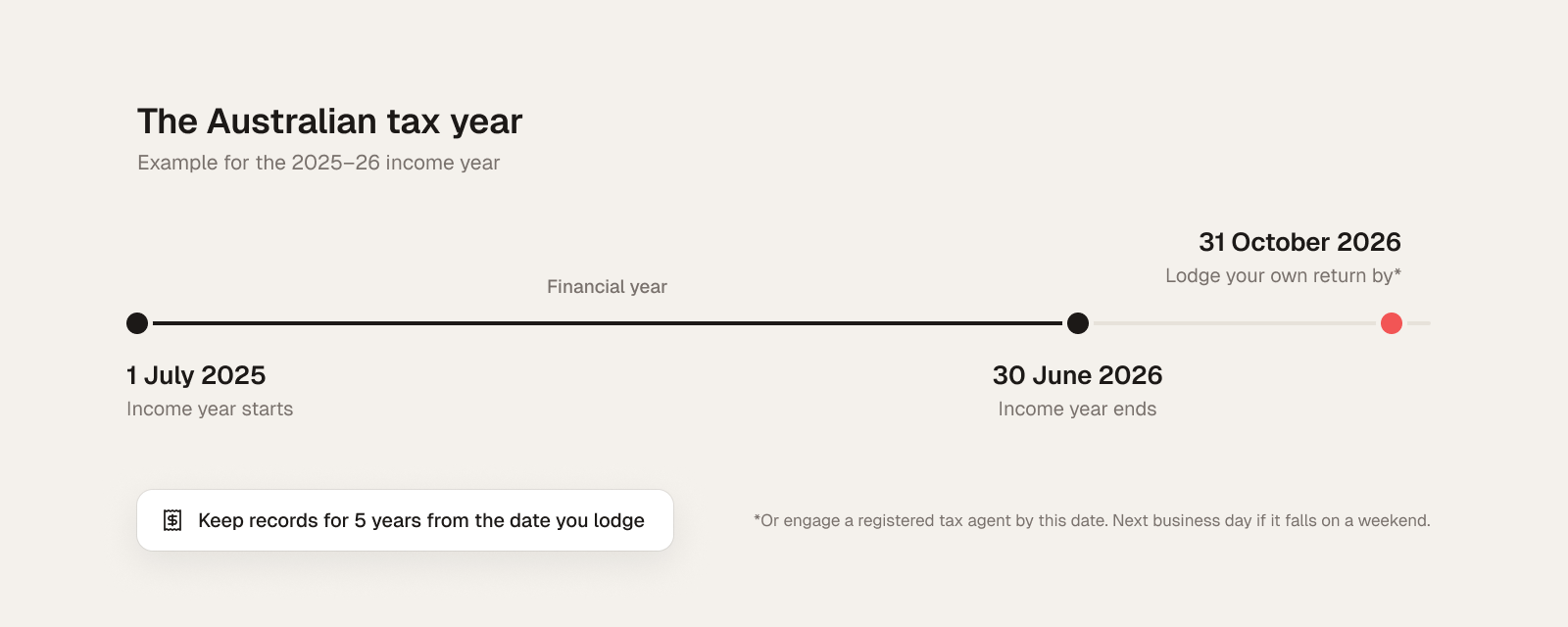
- The income year runs from 1 July to 30 June. Search that window, not the calendar year.
- Lodge by 31 October if you do your own return. If you use a registered tax agent, engage them before 31 October. Agents can often lodge later under their own schedule. See preparing your tax return.
- Keep records for 5 years from the date you lodge. Some records, such as those for depreciating assets, need to be kept longer. See records you need to keep. Sole traders must keep most business records for 5 years too. See the business record-keeping overview.
- Match every claim to a record. No receipt or bill means no claim, whatever the AI suggested.
- Remove anything your employer reimbursed.
- Check your working from home hours log covers the whole year. The ATO does not accept an estimate.
FAQ
Can ChatGPT or Claude do my tax return?
No. They can help you find and organise expenses. You or your tax agent still decide what to claim and lodge the return through myTax or an agent.
Is it safe to connect my bank to an AI assistant?
Redbark uses CDR consent, which you can revoke at any time from Redbark or your bank. For this task, grant read access only. Your transaction data goes into your AI conversation, so the AI provider's privacy settings apply from there.
Does the AI know the ATO rules?
It knows a lot, but it can be out of date or wrong. Check rules and rates on ato.gov.au before you rely on them.
Can I use this for my clients as an accountant?
Not through one login. Each person connects their own accounts under their own CDR consent. A client can connect their own bank and share a Google Sheet with you.
Which banks work?
Most Australian banks and credit unions through Open Banking, plus New Zealand banks through Akahu and US banks through Plaid. The ATO-specific prompts in this guide only apply to Australian tax.
Ready to try it? Start your 7 day free trial, connect a bank, and ask your assistant for last year's shortlist. Questions go to support@redbark.com.